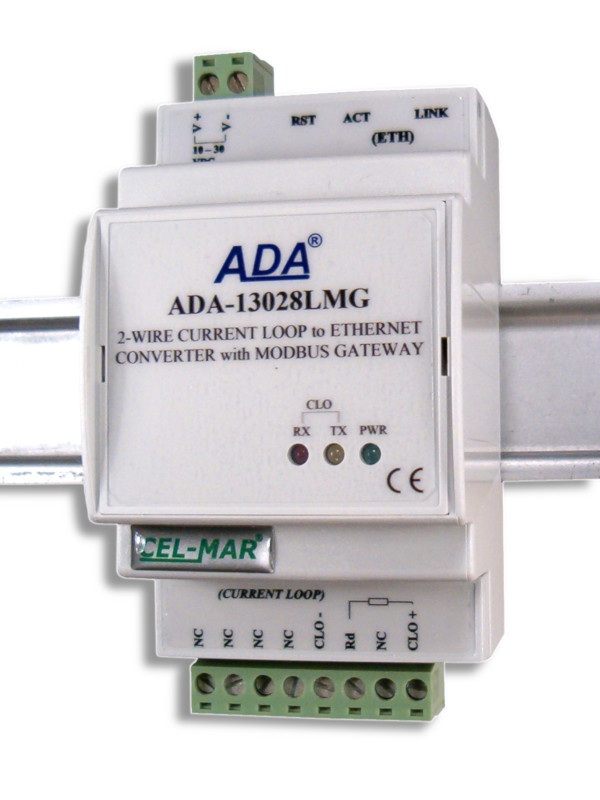
The ADA-13028LMG converter is a device designed for data transmission between devices equipped with current loop CLO interface over LAN/WAN network. Operation in an ETHERNET network can be carried out in the following modes: Virtual Serial Port mode, TCP serial bridge mode, UDP serial bridge mode, TCP sockets, UDP sockets, MODBUS Data Gateway. The MODBUS Data Gateway converts MODBUS-RTU/ SUNSPEC master/slave and MODBUS-ASCII master/slave protocol to MODBUS-TCP/UDP and inversely. This allows for integrate MODBUS-RTU/ SUNSPEC/ ASCII with MODBUS-TCP/UDP devices within one network. The converter has a built-in web server that enables remote configuration and management via a web browser.
The ADA-13028LMG converter enables data transmission (without changing the data format) via the CLO current loop interface at baud rate of up to 19.2 kbps., using the CLO+, CLO-, Rd signals.
It is equipped with a screw terminal block for twisted-pair CLO current loop and power connections, as well as an RJ45 connector for ETHERNET network connection.
Up to four devices operating in half-duplex mode can be connected to a CLO bus built using the ADA-13028LMG.
The converter is designed to be powered from an external DC power source with a voltage range of 10V to 30V and a minimum power rating of 3W. It features reverse polarity protection for the power supply and surge protection on the CLO bus. The device offers galvanic isolation between the power supply and both the ETHERNET and CLO interfaces, as well as optoisolation between the CLO and ETHERNET interfaces. The converter is also equipped with low-energy internal surge protection for each CLO current loop interface line. However, for lightning protection of the connection, external surge protectors should be used.
Drivers for Windows and Linux operating systems are available on our website. In Windows (Win98/ ME/ 2000/ XP/ 2003/ Vista/ 7/ 8/ 8.1/ 10/ 11), after driver installation, an additional COM port is created.
This port (e.g., COM3) can be used like a standard COM port. However, it is not a physical port present in the computer but a virtual one created by the system. As a result, DOS-based applications that attempt to use this virtual COM port may not function correctly.

 +48 41 362-12-46 ext.201
 sales@cel-mar.pl